

Water kefir / tibicos
Milk kefir versus water kefir
What is water kefir?
Benefits of drinking water kefir and using it on your skin
Recipe - how to make water kefir
Storage
Possible problems
What is the best size for water kefir grains?
Water kefir and fructose
Bacteria and yeasts in water kefir
Water kefir starter (USA supplier)
Water kefir starter (Australia only)
Fermentation accessories (Australia only)
References
Milk kefir versus water kefir
Milk kefir is described on a separate page. It is a highly nutritious probiotic drink made from milk.
What is water kefir?
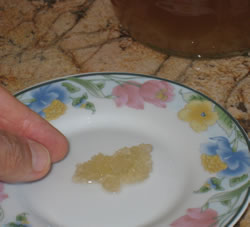
Water kefir is a fermented beverage teeming with beneficial probiotic bacteria. It is quick and simple to prepare, and once it is brewed, absolutely delicious. Even small children can enjoy it. It has a slightly sweet through to crisp, earthy, yeasty flavour, depending on how it was prepared. Sometimes when there are more yeasts in the brew it contains a tiny amount of alcohol and is slightly fizzy if bottled. Water kefir is a magnificent source of beneficial bacteria; it also contains a variety of enzymes and organic acids, and a range of B vitamins, vitamin K and folic acid (2).
Kefir means "feel good" in Turkish. Water kefir is also known as tibicos, tibi, sugar kefir, Japanese water crystals, bebees, Australian bees, African bees, California Bees, ale nuts, balm of Gilead or beer seeds.
Water kefir is made with kefir grains (small, translucent, gelatinous structures comprised of assorted bacteria and yeasts), water, and sugars. Kefir or tibicos cultures are found around the world, with no two cultures being exactly the same. Water kefir grains are translucent white and break easily when squeezed between the fingers. They more closely resemble irregular crystals. You can eat the kefir grains, they don't have much flavour but are a good probiotic.
If you don't want to consume dairy products then water kefir is an excellent non-dairy probiotic source. Other non-dairy probiotics include kombucha, sauerkraut and rejuvelac.
Do NOT dismiss water kefir because it contains sugars, and may appear high in sugar. It contains and promotes bacteria that eat sugars, and therefore need to live in a sugar medium. Water kefir heals candida, and is suitable for diabetics in small quantities provided they monitor their blood sugar level. The numerous benefits of water kefir are too significant to ignore.
The kefir grains are a culture of bacteria and yeasts held in a polysaccharide matrix created by some of the bacteria. The microbes in kefir grains act in symbiosis to maintain a stable culture. They can do this in many different sugary liquids, feeding off the sugar to produce lactic acid, acetic acid, alcohol (ethanol), and carbon dioxide gas which carbonates the drink. When properly cared for and regularly cultured, they produce a wonderful probiotic-rich beverage that continues to grow and reproduce indefinitely.
Water kefir is completely different to kombucha, with different bacteria and yeasts, different nutrients, different therapeutic benefits and a totally different flavour. You can't compare or replace the one with the other.
You can brew water kefir with a variety of fruits, coconut water, and various kinds of sugars, all of which come together to produce complex and beautiful flavours. After you have brewed your water kefir / tibicos, it is easy to add other flavours too.
Benefits of drinking water kefir and using it on your skin
Drinking Water Kefir can help you to achieve your optimal health, strengthen your immune system, and help to prevent diseases of all kinds. Most importantly, it restores good digestion - the key to health and longevity. When your body is out of balance, unfriendly opportunistic bacteria and yeasts can take over - producing irritable and bad digestion, food allergies, headaches, flu, skin rashes, and other more serious disorders. Water kefir is something you and your family can drink and use on your skin every day.
- Inhibits the growth of unfriendly bacteria and yeasts, and helps beneficial probiotic microorganisms to colonise and thrive in your digestive tract, and throughout the test of the body (skin, eyes, bladder, vagina, nose, throat, etc).
- Contributes to a healthy immune system.
- Reduces inflammation.
- Helps with the digestion of food and micronutrients. The KEY for health and longevity is good digestion, and a balance of good bacteria are the essential starting point.
- Heals, or reduces the symptoms of irritable bowel syndrome IBS) including bloating, indigestion, flatulence, diarrhoea/constipation, nausea, low energy, muscle aches and pains.
- Heals intestinal dysbiosis and SIBO (small intestine bacterial overgrowth).
- Increased energy and overall feeling of good health.
- Can stop unhealthy food cravings, especially for sugars and sweet foods.
- Skin complexion and overall condition improves. Brown liver spots / age spots can fade, as can skin tags, moles, warts etc. It can ease or cure many skin conditions, such as psoriasis, eczema and acne.
- Hair and nails look healthier, and are strengthened and improved.
- Liver cleansing, as in traditional Chinese medicine, thus easing aches and joint pains, and benefiting the eyes.
- Glandular ( endocrine) system (adrenals, thyroid, pituitary, ovaries) benefits. Women have healthier periods, some women have periods start again after early menopause.
- A tranquillising effect on the nervous system has helped many who suffer from sleep disorders and insomnia, depression, ADHD and autism.
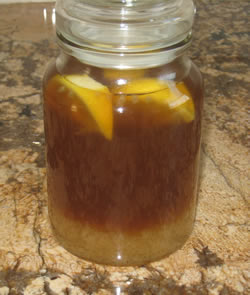
Recipe - how to make water kefir
Basically you put water kefir grains in a sugary water and let them ferment for 24 to 72 hours at room temperature. The final result will depend on the temperature, the particular sugars that you use, your kefir grain culture, the mineral content of the water, and the lack of pollutants in the water, and the sugars and fruits you may use.
Here is a typical recipe to make 1 litre / 1 quart of water kefir. You will need a 2 litre / 2 quart jar with loose lid or thin material cover, so there is air above your brew. You also need a sieve.
Get a starter:
Buy water kefir grains if you live outside Australia (USA supplier)
Buy water kefir grains if you live in Australia.
INGREDIENTS
- 4 cups / 1 litre / 1 quart of water (see below for details on which types of water).
- 1/4 cup / 60 grams / 2 oz of white/raw/brown sugar, sucanat, rapadura, agave nectar, jagari, palm sugar or maple syrup.
Alternatively, you can replace the sugarwater solution with coconut water (the juice from a fresh coconut).
Do NOT use honey unless your kefir grains have been adapted to honey - honey is an anti-microbial that will kill unadapted water kefir. - 1/4 cup of water kefir grains (or more).
- 1 or 2 teaspoons blackstrap molasses.
- 1/2 small/medium lemon, cut into two pieces, do not squeeze (optional). If you do not use a lemon, add a couple of tablespoons of your previous brew. This is good for acidity.
- Two dried organic apricots.
- 1 dried organic fig, halved.
- A small handful of raisins.
- 1 dried organic prune.
- 1/4 cup apple juice.
- banana - about 2cm / 1" cut into three slices.
Optional - try adding one or two of these:
METHOD
Dissolve the sugar in the water. If you heat it let it cool completely to room temperature. If it is hot you will kill the kefir grains. Put it in the jar, add the other ingredients and stir. There should be plenty of air space at the top of the jar.
Cover the jar with a piece of loose cloth, so it can breathe. Set the jar aside to ferment at room temperature in a cool place out of the sun.
Sometimes a few kefir grains will float, but mostly they stay on the bottom of the jar. It is not necessary to stir the kefir while it is fermenting, though gentle stirring or swishing the jar may help the fermentation.
When your brew is ready to bottle, pick out the pieces of fruit and discard them, then strain out the tibicos grains to make the next batch. The grains should have grown - ranging from almost no growth to doubling, depending on the conditions.
Temperature
The perfect temperature for water kefir is 22C / 71F. However, it will thrive in a range of 18-28C / 65-82F. At higher temperatures some of the microorganisms will still thrive, but others will die off and the symbiotic integrity of the culture may be lost. At lower temperatures your brew will be OK but will slow down. If you do not need kefir for a while you can keep it in the refrigerator as long as it is above 4C / 39F. Freezing water kefir grains will usually destroy them.
When is the kefir ready to bottle?
Your brew should take between 1 - 4 days, depending on the temperature, the amount and health of the grains you use, the ingredients, and the water quality. New starter grains will take longer, and may need a few generations to regain their full vigour.
Taste it. It is no longer flat, sweet water. It should be dry, slightly sour, with an acidic or tart bite along with just a little sweetness. It is important that it is not sweet. Leave it long enough that virtually all of the sugar is gone. There may be a few tiny bubbles effervescing when you move the jar. Depending on the ingredients you used, it may taste a little like a dry red wine, complex fruity, or have its own delicious unique flavour.
I like to leave my water kefir to brew for 4-5 days to get a really tart drink, especially in winter when it takes longer.
When you bottle the kefir, it continues to ferment, but more slowly, especially if it is in the refrigerator. After a few days there may be more carbonation (bubbles) and it will continue to become more tart and acidic (and very healthy). It is quite drinkable at any point so there is nothing to worry about. Once you get into the swing of things you will brew it the way you like it.
If you forget to bottle your kefir when it is ready, a few extra days will do no harm. After a long break you may still be able to continue to use the culture. Smell it, and make sure there is no mould. It may take a couple of brews to re-establish the full symbiotic balance of the bacteria and yeasts.
Storage
After you brew is ready, you can store it in a glass bottle at room temperature. If the lid is on tightly, it will develop a fizz or sparkle after a day or two, depending on the temperature, the level of residual sugar in your brew, and the particular yeasts that are in your culture. Warning: after a couple of days, considerable pressure may build up under some circumstances, and there is a danger of the bottle exploding. With your first few brews, I suggest that you gently release the cap to see how much pressure there is. After a few different brews, you get a feel for how long you can leave it.
If you put it straight into the refrigerator after bottling, you will get a still, rather than fizzy drink. If the lid is on tight, it may build up a little pressure, but it will take much longer.
You can store water kefir for years, the same as you can store wine. Its flavour and complexity changes, and it remains a delicious drink.
Possible problems
Insufficient acidity.
The kefir culture should be acidic, with a pH of 3.0 to 5.0. Adding a piece of fresh lemon or a little of your previous brew to your new brew will make it more acidic. If the kefir is not slightly acidic, there is a danger that moulds and other undesirable microorganisms can take hold.
Skin or scum on the surface.
A white or cream-coloured skin on the surface is common, and is usually a harmless kham yeast. Simply spoon it off and discard before you bottle your brew. It should not affect the taste, smell or health properties of the tibicos.
A translucent skin is caused by an imbalance in the bacteria/yeasts. I have seen a translucent skin after my water kefir had been in the refrigerator for a few weeks - after a couple of brews, things were back in balance.
A black, blue or dark brown coloured skin on the surface is a probably a mould. In this case discard the brew, wash everything carefully, throw away your grains, and start again.
The basic test is how does your brew smell? It should smell yeasty, earthy, fruity, vinegar and pleasant, but not foul.
Water.
The best water to use is mineral-rich water, hard water, or spring water.
The chlorine in tap water can kill the microorganisms in the kefir, so leave it in an open container for half a day for the chlorine to evaporate off. Tap water often contains other nasty ingredients that inhibit kefir fermentation, such as chloramine and fluorides. But normally tap water works well.
Filtered water is also OK. Remember that reverse osmosis (RO) filtered water and distilled water contain no minerals, so add some mineral drops to such water, use a tiny pin-head sized pinch of Celtic sea salt, or use mineral-rich blackstrap molasses in your recipe.
Do NOT use alkaline water to make water kefir. Water kefir needs an acidic environment and alkaline water will kill it.
Rinse your utensils well - do not leave any soap or detergents on them, as they will harm the kefir.
Fresh fruit should be organic if possible. Otherwise wash it carefully to remove herbicide and pesticide residues.
Dried fruit must be preservative-free, otherwise it will inhibit or kill the bacteria. Many dried fruits use preservatives, so try to buy organic.
Fast brew in less than a day.
If your brew is ready in less 24 hours and is very fizzy, you probably have an excess of yeast in it. Before you make the next batch, rinse the grains in fresh water and clean your brewing jar. Check the recipe to confirm that you are not using too much sugar, or try using a little less sugar than previously. A fast, fizzy, yeasty brew will have more alcohol in it, and will not have as much of the healthy complex acids and probiotic bacteria.
Metals.
Kefir can react with metals such as aluminium and iron, so don't brew it in a pot made from those metals. Ideally use a glass or ceramic jar to brew your kefir. Stainless steel and plastic utensils are OK.
What is the best size for water kefir grains?
Water kefir grains can vary in size from 1mm / 0.04" (the size of a grain of sand) to 5cm / 2" (the size of a small chicken egg). A batch of kefir will have a variety of sizes, but with most tending towards the same size.
The smaller the grains, the greater the surface area they have, and the faster they work. Smaller grains tend to be more consistent and produce a better flavour drink. However, mashing or breaking up the grains does not seem to improve them. Just let them grow to their own natural size.
The size of the grains depends on:
- Temperature. Warmer temperatures produce smaller grains, cooler temperatures make larger grains.
- Season. They really seem to know what the season is, regardless of the temperature inside the room. In summer, they produce smaller, faster-growing grains.
- Brewing time. The longer your usual brew time before a fresh batch of liquid is used to start the next brew, the smaller the grains.
- The recipe. Some recipes, with different sugars and fruits, produce smaller or larger grains.
- Stress. If the grains are stressed, they will be smaller.
Water kefir and fructose
Sucrose (table sugar) consists of a glucose and a fructose molecule linked together. The bacteria and yeasts in water kefir prefer to feed on glucose rather than fructose. (1) They convert the glucose into glucuronic acid and a variety of other acids, all with anti-bacterial and other beneficial properties. They convert fructose into acetic acid (vinegar) and other organic acids.
Because of this preference for glucose, most of the glucose is quickly consumed. The sugar that remains in your water kefir is mostly fructose. The longer you leave your water kefir to brew, the more it also uses up this remaining fructose. (3)
Unlike most other sugars, fructose can only be metabolised in your body through your liver. You should limit the amount of fructose that you consume, especially if your liver is not as healthy as it could be. This means avoiding fruit juice, large quantities of sweet fruit, and of course most processed and restaurant foods which all have large quantities of sugar / HFCS added.
Water kefir is a source of fructose, especially sweet brews that have been made in only a day or two. Small quantities of well-fermented water kefir are of course highly beneficial, but it seems to me that it is not a good idea to drink more than a glass per day of water kefir, especially sweet short-fermented brews.
This suggests that you can substitute glucose powder for sucrose in the water kefir recipe. I made a brew in which a quarter of the sugar was substituted with glucose, and it seemed to work OK. It seems that nobody has yet tested this important question. If anyone has further information or laboratory results, I would be most grateful if you would contact me.
Bacteria and yeasts in water kefir
A variety of bacteria and yeasts exist in the kefir grains and liquid (1, 2). Bacteria are not like other living organisms that breed true according to a genetic program that is transmitted only vertically from parent to offspring. Instead, bacteria morph from one species to another, partly by means of horizontal transfer of genes by various weird and wonderful biological mechanisms (other than sex, which by definition cannot occur in bacteria). Thus, the species-designations in bacteriology are matters of convenience and are misleading inasmuch as they imply some sort of genetic integrity which may or may not be there. It seems perfectly possible for one species of Lactobacillus to morph into another in response to environmental conditions, and indeed I would assume it is also possible for Lactobacillus to morph into other bacilli. With bacteria it is more or less the case that whatever the environment dictates will spontaneously appear. So microbial species lists, while interesting, are not definitive.
Bacteria:
Acetobacter.
A. fabarum.
A. orientalis.
Bacillus.
B. subtilis.
B. graveolus.
Lactobacillus.
L. acidophilus.
L. alactosus.
L. brevis has been identified as the species responsible for the production of the polysaccharide (dextran) that forms the grains.
L. bulgaricus.
L. casei. Produces lots of lactic acid; colonises well in the gastric tract; creates a favourable medium in which other beneficial
bacteria can grow; inhibits putrefaction and harmful bacteria; increases immune function; helps protect against bacterial infections.
L. casei ss. (subspecies) casei.
L. casei ss. pseudoplantarum.
L. casei ss. rhamnosus.
L. casei ss. tolerans.
L. coryneformis ss. torquens.
L. fructosus.
L. hilgardii.
L. homohiochi.
L. hordei.
L. nagelii.
L. plantarum. Produces lactic acid; fights Listeria monocytogenes; makes plantaricin; inhibits a large number of Gram-positive bacteria - the type of bacteria that cause spoilage.
L. plantarum.
L. pseudoplantarum.
L. reuterietc.
L. yamanashiensis.
Leuconostoc.
L. mesenteroides.
L. citreum.
Pediococcus damnosus.
Streptococcus.
S. agalactiae.
S. bovis.
S. cremoris. Has similar properties to S. lactis.
S. diacetylactis. Produces carbon dioxide in the kefir; makes diacetyl, which gives kefir its characteristic odour; other properties similar to S. lactis.
S. faecalis.
S. lactis. Produces lactic acid, aids digestion, inhibits harmful microorganisms, produces bacteriolysins.
S. mutans.
S. pneumonia.
S. pyogenes.
S. salivarius.
S. sanguinis.
S. suis.
S. viridans.
Yeasts:
Candida.
C. lambica.
C. lamica.
C. gueretana.
C. valida.
Hansenula valbyensis.
Kloeckera apiculata.
Lachancea fermentati.
Saccharomyces.
S. bayanus.
S. boulardii.
S. cerevisiae.
S. florentinus.
S. pretoriensis.
S. uvarum.
Torulopsis insconspicna.
Zygotorulaspora florentina.
Water kefir grains if you live outside Australia (USA supplier)
Water kefir grains if you live in Australia
Fermentation accessories (Australia only)
References
1. Gulitz A., Stadie J., Wenning M., Ehrmann M.A., Vogel R.F.
The microbial diversity of water kefir.
International Journal of Food Microbiology. December 2011,15;151(3):284-8. Epub 2011 Sep 24.
2. K. Ramotar, J. M. Conly, H. Chubb, T. J. Louie.
Production of Menaquinones by Intestinal Anaerobes
The Journal of Infectious Diseases, Vol. 150, No. 2, Augugust 1984. (pp. 213-218)
3. David Laureys, Luc De Vuyst.
Microbial Species Diversity, Community Dynamics, and Metabolite Kinetics of Water Kefir Fermentation.
Appl. Environ. Microbiol. April 2014 vol. 80 no. 8 2564-2572.